Mission engineering & integration
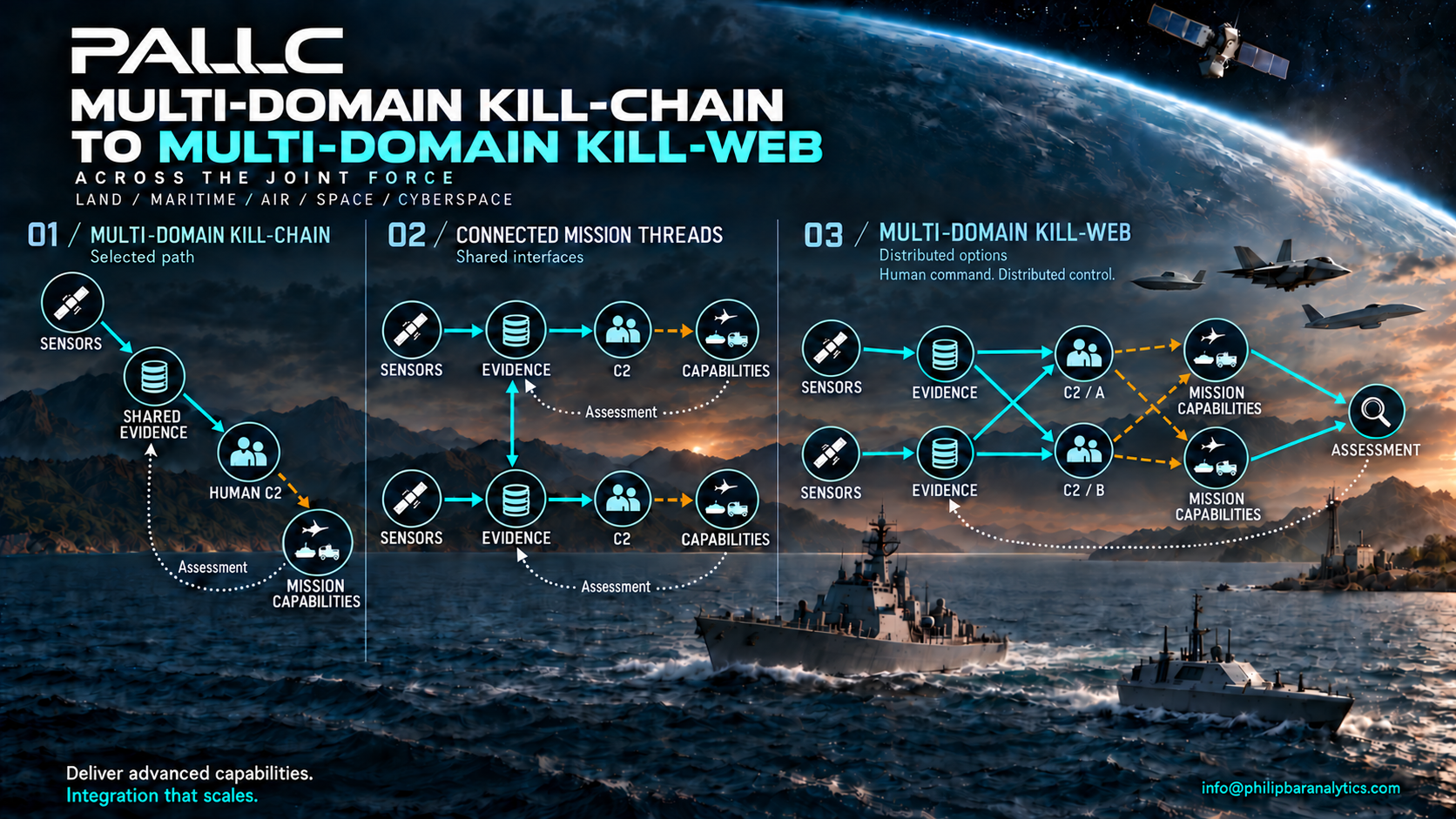
Connect mission requirements, system architectures and interfaces. Evaluate how capabilities perform together before committing to a design or integration decision.
Explore mission engineering

DEFENSE / SCIENCE / ENGINEERING / SYSTEM INTEGRATION
PALLC integrates engineering tools, authoritative models and data within one adaptively scalable, SI-augmented Digital Engineering, Modeling & Simulation environment. We automate model development and integration so programs can compare system configurations, identify interaction problems and focus test and evaluation on mission requirements.
Explore capabilitiesCAPABILITY DEVELOPMENT / MISSION PREPARATION
PALLC connects requirements, executable system models and computational physics across design, test and evaluation, exercises and analytical wargaming. Automating model development, transformation and integration reduces manual reconciliation as designs and configurations change. Programs can compare system configurations and establish integration and test priorities; exercise sponsors can examine courses of action, rehearse coordination and assess participant performance against event objectives.
Connect mission requirements, system architectures and interfaces. Evaluate how capabilities perform together before committing to a design or integration decision.
Explore mission engineeringExamine courses of action, rehearse coordination and assess performance against operational objectives through designed scenarios, facilitation and after-action analysis.
Explore exercises & wargamingResolve consequential physical interactions, quantify uncertainty and focus model resolution on the design factors and operating conditions that govern the outcome.
Explore computational physicsIntegrate frontier SI with authoritative information, persistent project context and engineering tools. Develop and evaluate automation within the customer’s network and cybersecurity requirements.
Explore SI-enabled developmentZMS + MODELSHIFT / RECORDED WORKFLOW
Select a chapter to see model loading, mission testing, verification and export.
Recorded ZMS execution: 25/25 execution checks and 6/6 bounded physics checks. SysML v2 textual validation covers an export from a separate run of the same package.
ZMS / MULTI-DOMAIN TRACKING
Replay aircraft, maritime, ground and orbital activity in one mission workspace.
0:00 Aircraft and maritime-contact inspection. 0:04 MEO and ground-link context. 0:08 LEO satellite inspection. 0:12 Land-force entity and SysML activity. These are recorded exercise views.

Dynamical systems, computational physics and model reduction support repeated analysis.
Test feedback guides accepted model changes.
Compare design alternatives and select the next test.
TECHNOLOGY PORTFOLIO
01 / Engineering prototype
Connect engineering requirements and system models to executable analysis, change assessment and V&V.
Explore ModelShift02 / Research prototype
Connect executable models, mission observations and participant decisions in a shared engineering and geospatial environment.
Explore ZMS03 / In development
Develop SI-assisted exercise preparation from mission objectives to scenarios, execution and assessment.
Explore ForceWeaverPALLC / RESEARCH
Preprint · Hypersonic computational fluid dynamics
Abstract excerpt
A developed reacting-air solution is transferred to an unchanged, 41,962,496-hexahedron domain through an admissibility-checked continuation method. Seven species, two thermal energies, and shear-stress-transport turbulence are coupled through thermodynamic, acoustic, charged-transport, and nonlinear-update equations.
Read the paperWhite paper · 2026
Abstract excerpt
We present a System Entity Structure methodology for orchestrating large language model agents as a Discrete Event System Specification coupled model, with verification and validation carried out through the DEVS hierarchy of system specifications and its morphisms.
Read the paperPublished article · 2026
Abstract excerpt
Artificial intelligence (AI) for systems engineering has evolved through six paradigms in five decades: expert systems, machine learning, deep learning, large language models, agentic AI, and agentic swarms, with each paradigm shorter than the last.
Read the paperPublished symposium paper · 2026
Abstract excerpt
The future of systems engineering (FuSE) calls for increased rigor, grounded in math‐based approaches.
Read the paperWhite paper · MODSIM World 2026
Abstract excerpt
The digital thread remains fragmented in practice: requirements, architectures, models, and verification evidence are exchanged through documents and manual reconciliation rather than machine-verifiable relationships, and Modeling & Simulation (M&S) therefore functions as a downstream report about the system rather than the system's authoritative executable representation.
Read the paperResearch collaboration · 2026
Abstract excerpt
We present a four-arc progressive assessment system with a geospatial common operational picture (COP), developed during the IGNITE '26 hackathon (March 16–19, 2026).
Read the paperPALLC presentation · 2026
Abstract excerpt
The convergence of three quantum computing milestones in twelve months has compressed the post-quantum cryptography (PQC) migration timeline from a next-decade concern to a present-day operational imperative.
Read the paperSI-ENABLED ENGINEERING / RESEARCH & DEVELOPMENT
Abstract excerpt
Commercial frontier AI advances through a global system of computation, research, software development and feedback. Deploying a model inside a defense network does not reproduce the system that continually advances its capability.
Read the paperAGENTIC SI / MODELING & SIMULATION
Abstract excerpt
Bernard P. Zeigler established a rigorous systems foundation for model-based intelligent agents. With his collaborators, he developed architectures in which agents use internal representations to plan actions, monitor consequences, coordinate with other agents, and recover when execution departs from expectations.
Read the paperHETEROGENEOUS MODELING & SIMULATION / DEVS
Overview
Philipbar Analytics LLC’s Artificial Intelligence for Gaming, Exercise, Modeling & Simulation (PALLC AI-GEMS) applies PALLC’s expertise in the Advanced Framework for Simulation, Integration and Modeling (AFSIM), Joint Simulation Environment (JSE), Next Generation Threat System (NGTS), and heterogeneous co-simulation to a common integration problem: preserving temporal event synchronization across independently developed models and simulators.
Read the paper